
Not Everyone Breathes the Same Air
Not Everyone Breathes the Same Air
“Life isn’t fair” is something most of us hear growing up, but it takes on a whole new meaning when you realize it applies even to the air we breathe. The United States is built on the promise of life, liberty, and the pursuit of happiness, but that promise feels hollow when poor air quality puts those ideals at risk. As a medical student, I have learned a lot about the physiology of how polluted air damages the lungs, and it has made me eager to effect change on a local level. Kids in Colorado and across the US are growing up exposed to airborne chemicals, including carcinogens, that increase their risk for adverse health effects, often without even realizing it. In Colorado, this exposure isn’t shared equally. Some communities experience far poorer air quality than others. So, the real question isn’t just why air pollution exists, it’s who is forced to live with the consequences.

Pollutants Released During the Fossil Fuel Cycle
From drilling and fracking to refining and transportation, oil and gas production emits toxic chemicals which negatively affect air quality and pollute surface and groundwater [1,2,3]. Production uses or releases toxic chemicals such as benzene, formaldehyde, naphthalene, and acrylamide, which are known to pose risks to human health [2,4,11,12,13]. The state of Colorado has identified benzene and formaldehyde as “Priority Toxic Air Contaminants,” due to their impacts on human health [14]. Also, according to the United States Environmental Protection Agency, benzene is a known human carcinogen, formaldehyde is a known human carcinogen, naphthalene is a possible human carcinogen, and acrylamide is likely to be carcinogenic to humans [4,11,12,13]. A carcinogen is defined as a substance or agent that can cause or increase the risk of cancer.
While the entire Denver metro population suffers the negative impacts of the area’s high level of ozone, a regional pollutant formed through chemical reactions with emissions in the atmosphere, not all areas are equally affected [6]. It may come as a surprise to some, but residents of Commerce City and North Denver's Globeville-Elyria-Swansea (GES) area experience higher exposure to toxic air pollutants than the rest of the metro area [5]. GreenLatinos’ report entitled Who Bears the Cost? documents the cumulative impacts of emissions from multiple local sources including nearby oil refining, heavy diesel truck traffic, and rail yard activity affecting the area [5]. Along with the air pollutants cited thus far, this area is also a hotspot for fine particulate matter pollution, known as PM2.5. These particles are smaller than 2.5 micrometers in diameter, which, due to their small diameter, can penetrate the lungs and enter the bloodstream [7]. As a result, their health effects are widespread and devastating, including, but not limited to stroke, type 2 diabetes, pneumonia, lung disease, and more [7]. As a result of all the pollutant sources being aggregated in one area, the local population faces a disproportionately higher health risk when compared to other parts of the Denver metro area and the state [5]. While residents all across the state benefit from increased access to fossil fuel products, the environmental and health burdens lie disproportionately heavier on the population in specific regions such as Commerce City [5].
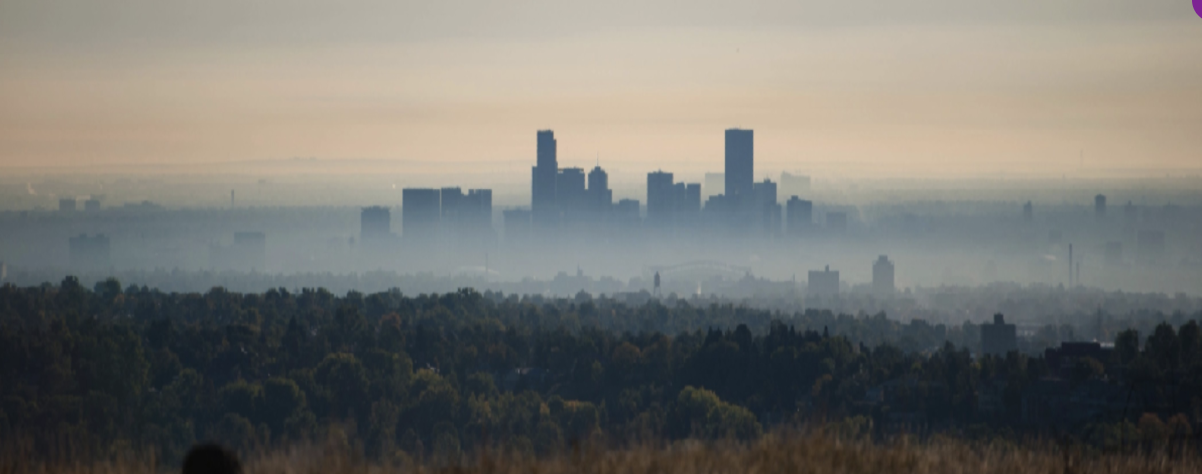
Denver smog image accessed from https://www.rawpixel.com/image/3322598/free-photo-image-air-pollution-building-cc0
The Current State of Colorado Air Quality
While Colorado is home to great mountains, beautiful streams and endless outdoor activities, if you live in Denver, your lungs may be paying the price for such beauty and recreation. According to the American Lung Association's 2026 State of the Air report, the Denver-Aurora-Greeley metropolitan area ranks eighth in the nation for ozone pollution [8]. Despite having a population of approximately 3 million, ozone pollution levels in the Denver metropolitan area rank higher than those of much larger metropolitan areas, including Dallas with approximately 8.3 million residents, and Chicago with approximately 9.4 million residents [8,9]. Furthermore, counties including Adams, Arapahoe, and Boulder have repeatedly failed to meet EPA ozone pollution standards, contributing to the Denver Metro/North Front Range region’s official redesignation to “severe” ozone nonattainment status in 2022, the second worst category possible [6]. The contrasts show that population alone cannot explain Denver’s air quality, and likely point to industrial emissions and fossil fuel production as key contributors.
The Path Forward
Colorado produces large amounts of crude oil and methane gas, some of which is refined locally, while some is transported out of state for refining. Oil production in Colorado creates some jobs, provides property tax revenue, and supplies fuel for the region; however, these benefits come with trade-offs, including pollution and negative health effects at nearly every stage of the process. According to a report by the Colorado Fiscal Institute, “The oil and gas extraction industry, along with the pipeline construction and transportation industries and support industries for oil and gas make up just 1.8% of total wages in the state, 3.4% of total personal income, 3.3% of GDP and less than 1% (0.7%) of total employment” [10]. The same report also found that “Climate-caused disasters alone have cost the state between $20 billion and $50 billion since 1980,” while “the cost of plugging and cleaning up a well can range from an average of $20,000 per well, to over $1 million depending on the type and age of the site” [10]. These findings suggest that the economic benefits of oil production are accompanied by substantial long-term environmental and financial costs [10].
Beyond the financial costs to society as a whole, pollution disproportionately affects certain communities, particularly areas such as Commerce City near the Suncor refinery, increasing pain and suffering and the cost of healthcare to individuals, taxpayers and businesses [5]. Pollutants with serious health impacts, including PM2.5 and ozone-forming emissions, are often concentrated in these communities, increasing health risks for local residents. Addressing air quality and public health in Colorado therefore requires not only broad reductions in pollution overall, but also targeted efforts in communities that bear the greatest environmental burden. Every child deserves the opportunity to grow up happy and healthy regardless of where they live. By addressing these environmental disparities today, we can build a more equitable, just and healthy future for all generations to come.
Sources:
[1] U.S. Environmental Protection Agency. Basic Information about Oil and Natural Gas Air Pollution Standards. U.S. Environmental Protection Agency. https://www.epa.gov/controlling-air-pollution-oil-and-natural-gas-operations/basic-information-about-oil-and-natural
[2] U.S. Environmental Protection Agency. Hydraulic Fracturing Drinking Water Assessment: Executive Summary. U.S. Environmental Protection Agency. https://www.epa.gov/sites/default/files/2016-12/documents/hfdwa_executive_summary.pdf
[3] Natural Resources Defense Council. Natural Gas 101. NRDC. https://www.nrdc.org/stories/natural-gas-101
[4] U.S. Environmental Protection Agency. Benzene CASRN 71-43-2 | IRIS. U.S. Environmental Protection Agency. https://cfpub.epa.gov/ncea/iris2/chemicalLanding.cfm?substance_nmbr=276
[5] Colorado School of Public Health and GreenLatinos. Who Bears the Cost? North Denver Environmental Justice Report and Data Audit. GreenLatinos. https://www.greenlatinos.org/wp-content/uploads/2024/04/N-Denver-Report_English_Online_workinghyperlinks.pdf
[6] Colorado Department of Public Health & Environment. History of Ozone in Colorado. Colorado Department of Public Health & Environment. https://cdphe.colorado.gov/ozone-and-your-health/history-of-ozone-in-colorado
[7] Health Effects Institute. PM2.5. State of Global Air. https://www.stateofglobalair.org/pollution-sources/pm25
[8] American Lung Association. Most Polluted Cities | State of the Air. American Lung Association. https://www.lung.org/research/sota/city-rankings/most-polluted-cities
[9] Wikipedia. List of North American Metropolitan Areas by Population. Wikipedia. https://en.wikipedia.org/wiki/List_of_North_American_metropolitan_areas_by_population
[10] Colorado Fiscal Institute. The Economic Impact of Oil and Gas in Colorado (2023). Colorado Fiscal Institute. https://www.coloradofiscal.org/wp-content/uploads/2023/01/OG-paper-2023-1-17-23.pdf
[11] U.S. Environmental Protection Agency. Formaldehyde CASRN 50-00-0 | IRIS. U.S. Environmental Protection Agency. https://iris.epa.gov/ChemicalLanding/&substance_nmbr=0419
[12] U.S. Environmental Protection Agency. Naphthalene CASRN 91-20-3 | IRIS. U.S. Environmental Protection Agency. https://cfpub.epa.gov/ncea/iris2/chemicalLanding.cfm?substance_nmbr=436
[13] U.S. Environmental Protection Agency. Acrylamide CASRN 79-06-1 | IRIS. U.S. Environmental Protection Agency. https://cfpub.epa.gov/ncea/iris2/chemicalLanding.cfm?substance_nmbr=286
[14] Colorado Department of Public Health & Environment. Priority Toxic Air Contaminants. Colorado Department of Public Health & Environment. https://cdphe.colorado.gov/air-toxics/priority-toxic-air-contaminants